
A Practical Guide to Surveys, Engineering, Permits, and Driveway Installation in Colorado
You own a piece of mountain land. Maybe you bought it years ago with plans that never quite materialized. Maybe you inherited it from family. Maybe you just closed escrow last month and you’re ready to finally do something with it.
For most landowners, the first goal is simple: get access. Cut in a driveway. Create a flat spot to park a truck or stage a camper. Make the property usable so you can actually spend time on it – camp on weekends, bring the family up, start figuring out where a cabin might go someday.
That sounds straightforward enough. But here’s where it gets complicated.
Colorado’s mountain counties – Jefferson, Clear Creek, Grand, Park, Gilpin – all have specific requirements for driveway construction. Grade limits. Culvert sizing. Drainage plans. Engineering stamps. Permit applications that can take months to review. And if you do things out of order, or skip a step, you can end up paying twice: once to undo whatever you built wrong, and again to do it right.
This guide walks through the correct order of operations for developing raw land, with a focus on mountain and Front Range properties. We’ll cover what each step involves, what it costs, and what the counties actually require. Understanding this sequence upfront can save you months of delays, thousands in wasted money, and a lot of frustration with county offices.
The Correct Order for Developing Raw Land
Every step in land development feeds the next. You can’t get engineering plans without a survey. You can’t submit a permit without engineering. You can’t start construction without a permit. Skip ahead, and you’ll hit a wall.
Here’s the sequence that works.
1. Topographical Survey
Estimated Cost: $1,500 – $3,000
Before anything else happens, you need a topographical survey. This is the foundation document that everything else builds on – your engineer needs it to design the driveway, and the county needs it to review your permit application.
A topo survey documents what currently exists on your property:
- Elevation changes and slope percentages across the site
- Natural drainage paths and low points where water collects
- Trees, rock outcroppings, and significant terrain features
- Property boundaries, setbacks, and any recorded easements
In mountain terrain, most counties require 1-foot or 2-foot contour intervals – much more precise than the 5-foot contours sometimes used for basic site evaluations. Clear Creek County, for example, explicitly requires a topographic and boundary survey for any project proposing disturbance on slopes with an existing grade over 10%. (Clear Creek County Site Development)
That 10% threshold sounds steep until you realize that most mountain parcels exceed it. If you’re looking at land in the foothills or high country, assume you’ll need the detailed survey.
Costs vary based on access, slope, tree cover, and parcel size. A relatively flat 1-acre lot with good road access might come in around $1,500. A steep, heavily wooded 5-acre parcel with no existing road could push $3,000 or more. Turnaround is typically 1-4 weeks depending on surveyor workload and site complexity.
The survey must be performed by a Colorado-licensed Professional Land Surveyor (PLS). Without this document, an engineer cannot design your driveway, and a permit cannot be submitted.
2. Engineering & Site Planning
Estimated Cost: $1,800 – $3,500
Once the topo survey is complete, it goes to a civil engineer. The engineer uses this data to design your driveway alignment – figuring out the best route across your property, the grades that will work within county limits, where drainage needs to be managed, and how to minimize earthwork.
Engineering plans for a mountain driveway typically include:
- Driveway centerline location, width, and grade percentages
- Cut-and-fill limits showing how much earth gets moved
- Drainage improvements and culvert sizing
- Turnaround dimensions and parking areas
- Fire department access requirements
- Consideration for future home construction or utilities
This step matters more than most landowners realize. A properly designed driveway can reduce construction costs significantly, minimize the need for retaining walls, and avoid expensive rework when you eventually build a home. The engineer is thinking ahead to where utilities will run, where a septic system might go, and how construction equipment will access a future building site.
The specific requirements vary by county, and the differences can catch you off guard.
Jefferson County allows a maximum driveway grade of 10% on straight sections, with an exception allowing 12% on south-facing slopes where better sun exposure helps with ice melt. Curves with a radius of 50 feet or less are capped at 8%. (Jefferson County Transportation Design & Construction Manual)
Clear Creek County allows up to 12% on straight sections but restricts the first 25 feet from the road to 8%. (Clear Creek County Driveway Standards)
Grand County is the strictest at the entrance: the first 50 feet from a county road cannot exceed 5%, which is a much more conservative standard than its neighbors. (Grand County Driveway Permit Requirements)
These grade limits matter because your property’s natural terrain may or may not accommodate them. A good engineer finds the route that works within the rules while minimizing excavation costs. A bad design – or no design at all – leads to failed inspections, costly redesigns, or driveways that become impassable in winter.

3. Driveway Permit Application & County Review
Estimated Cost: $500 – $2,000
With engineered plans in hand, you can now submit for a driveway permit. This is where the county reviews your proposal to make sure it meets their standards for safety, drainage, and road access.
Permit costs and timelines vary significantly by county:
Jefferson County: The access permit itself costs $50 for zoning review. But if your project involves land disturbance exceeding half an acre, you’ll also need a grading permit at $1,200, plus Grading, Erosion, and Sediment Control (GESC) plans. The grading permit review alone can take 3-4 months from submittal to initial comments. (Jefferson County Engineering and Earthwork)
Clear Creek County: Applications must be submitted electronically at least 15 calendar days before planned construction. A Right-of-Way permit costs $340 for any work within county right-of-way, and notably, ROW work permits are only issued between May 1 and October 31 each year. Miss that window, and you’re waiting until spring.
Grand County: The permit fee is $125, and installing a driveway without a permit triggers a $500 fine. The county requires you to mark the centerline of your proposed driveway with wooden lath for the first 50 feet and display the property address before submitting your application.
County review focuses on several key areas:
- Safe access to public roads with adequate sight distance
- Proper drainage and erosion control measures
- Culvert sizing appropriate for storm flows
- Compliance with county road standards or CDOT right-of-way requirements
Revisions are common, especially in mountain areas with difficult terrain. Having an experienced team involved from the beginning – someone who knows what each county looks for – can significantly reduce the back-and-forth that delays projects.
If your property accesses a state highway rather than a county road, you’ll also need a CDOT access permit. The fee is modest ($50 for residential), but the review adds another 45 days to your timeline, and sight distance requirements on mountain highways can be deal-breakers for some properties. (CDOT Access Permits)

4. Construction Staking
Estimated Cost: $1,200 – $2,500
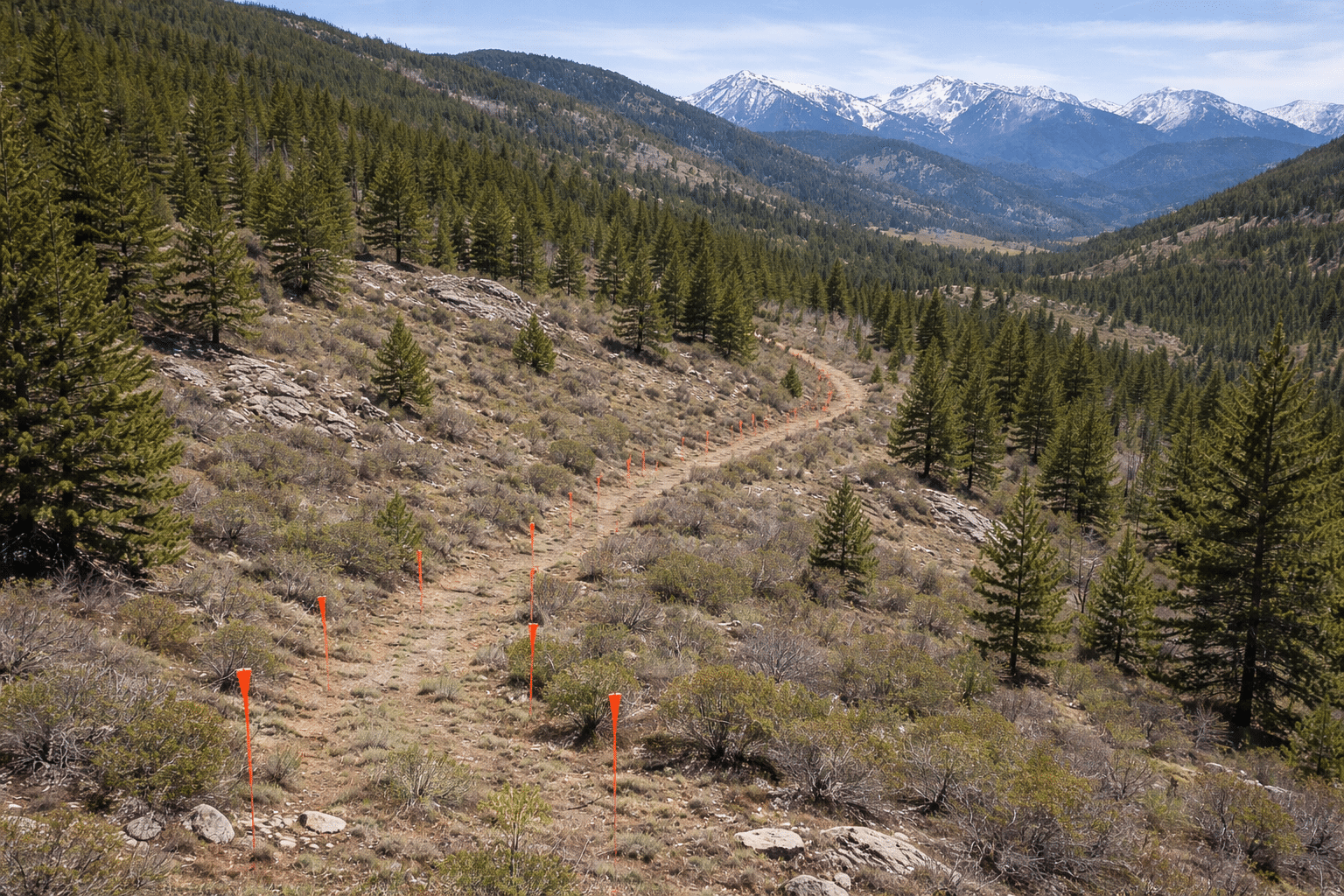
Once the permit is approved, the engineer or surveyor returns to stake the project in the field. This happens after permitting but before any construction begins.
Staking translates the engineering plans into physical markers on the ground:
- Driveway centerline positions
- Grade reference points at key stations
- Cut and fill slope limits
- Culvert locations
- Retaining wall positions (if applicable)
For mountain driveways, precise staking is critical because you’re often working with tight grade tolerances. When the county allows 10% maximum and your terrain naturally runs at 12%, the difference between a compliant driveway and a failed inspection comes down to inches of elevation over short distances. Small positioning errors during construction can push sections over the allowable grade.
Skipping or rushing this step leads to predictable problems: failed inspections, stop-work orders, or costly corrections after the fact. We’ve seen landowners try to save money by eyeballing it, only to spend far more fixing the results.
Costs for construction staking on mountain properties typically range from $1,200 for simple sites to $2,500 or more for complex terrain with multiple grade breaks or structural elements. Staking is usually billed per trip, and you may need multiple visits as construction progresses through grading, culvert installation, and surface finishing.
5. Driveway & Access Construction
Estimated Cost: $5,000 – $15,000+
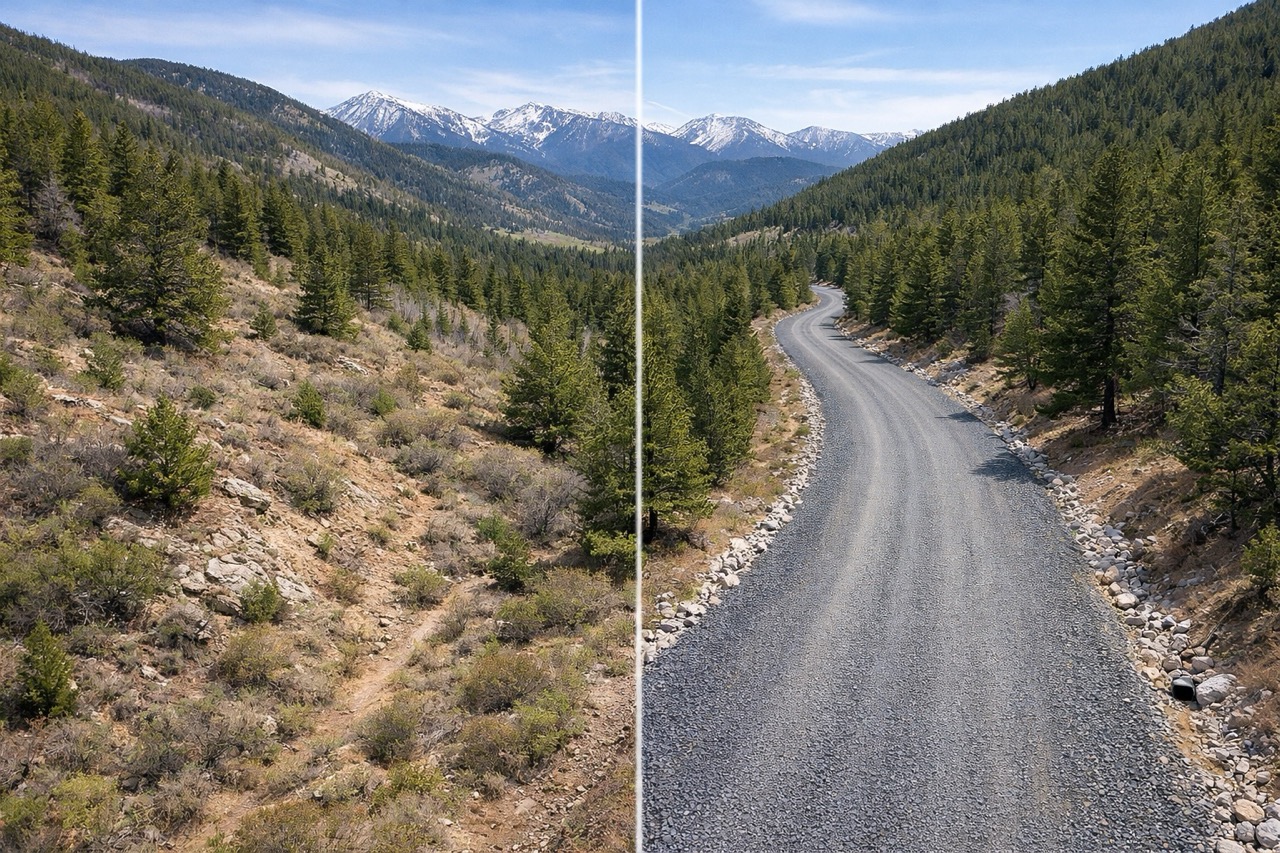
Construction is the final step and where costs vary the most. This is the actual earthwork – excavating the route, building up the road base, installing culverts, placing gravel, and getting everything graded to the specifications in your approved plans.
Pricing depends on several factors:
- Length and width of the driveway – A 200-foot driveway costs less than a 500-foot driveway
- Slope and cut-and-fill requirements – Steeper terrain means more dirt moving
- Soil conditions – Hardpan digs differently than decomposed granite or solid rock
- Rock hammering or blasting – If you hit bedrock, costs increase significantly
- Retaining walls – Steep side slopes may require structural reinforcement
- Drainage improvements – Culverts, swales, and erosion control add cost but prevent future problems
A basic gravel driveway on favorable terrain – relatively flat, good soil, short length – might come in around $5,000. Steeper mountain properties with rock, longer runs, and structural elements can easily exceed $15,000. Complex sites with extensive retaining walls or switchbacks can go higher.
The materials matter too. Generic pit-run gravel breaks down quickly under freeze-thaw cycles. We use road base and surface gravel selected specifically for Colorado’s mountain conditions – materials that compact properly and stay stable through winter.
Owner-Managed vs. Full-Service Approach
Owner-Managed Process
Some landowners choose to manage the development process themselves. This typically involves:
- Hiring a surveyor directly
- Finding and coordinating with a civil engineer
- Submitting permit applications and responding to county comments
- Scheduling construction staking
- Hiring and managing a contractor for the build
This approach can work well for owners who have the time, are comfortable navigating county bureaucracies, and don’t mind coordinating multiple professionals across several months. If you’ve done construction projects before and know how to read engineering plans, you can save money by handling the coordination yourself.
The tradeoff is time. Managing four or five different professionals, responding to county review comments, scheduling site visits, and keeping everything moving requires consistent attention. If you’re doing this from out of state, or while working a full-time job, the process can drag.
Full-Service Option with Mountainside Land Services
For clients who want a more streamlined experience, we can manage the entire process from survey through construction.
For a set consulting fee, we handle:
- Coordinating topographical surveys and engineering
- Submitting and managing permit applications
- Responding to county comments and revision requests
- Acting as the single point of contact with the county
- Attending site meetings and inspections
- Constructing the driveway with future development in mind
We work in Jefferson, Clear Creek, Gilpin, Park, Summit, and Grand counties regularly. We know what each county looks for, which reviewers are strict about which issues, and how to put together applications that move through the process without unnecessary delays.
When we build a driveway, we’re also thinking ahead to what comes next – where utilities might run, how construction equipment will access a future building site, where drainage needs to be managed long-term. A driveway built with future construction in mind saves money when that future construction actually happens.
Why Access Is Often the First Smart Investment
Even if building is years away, installing proper access early makes sense for several reasons:
You can actually use your land. A permitted driveway and a flat parking area means you can bring up a camper, stage equipment, or just spend weekends on your property while you plan the next phase.
It improves resale value. Raw land with legal, permitted access is worth more than raw land without it. If your plans change, you’ll recoup the investment.
It reduces future construction costs. When you’re ready to build, the access is already in place. Contractors can get equipment to the site. Materials can be delivered. You’re not paying to solve the access problem under time pressure.
It makes future utilities, wells, and septic easier. Drillers and installers need to get their equipment on site. A proper driveway makes that possible.
For many landowners, a well-designed driveway is the foundation for everything that comes next. It’s the first real step toward turning a piece of raw land into a property you can use, enjoy, and eventually build on.
Looking to start developing your property?
If you own land in Colorado’s mountain communities and want to talk through your options, reach out. We’re happy to walk through the process, answer questions about your specific county, and help you figure out the right approach for your property.
Phone: 720-303-1449
Email: jason@mountainsidelandservices.com