
Mountain driveways cost more than flat-land driveways. That’s the reality of building on steep grades, rocky soils, and terrain that requires drainage planning most contractors in the Denver metro never have to think about.
The range is wide because no two mountain properties are the same. A renovation on an existing gravel driveway might start around $3,500. A new driveway on raw, undeveloped mountain land can run anywhere from $10,000 to $50,000 or more depending on length, grade, rock conditions, and how much clearing and drainage work the site requires.
Here’s how those numbers break down.
What a Driveway Renovation Costs
Starting at $3,500+
A renovation covers an existing gravel or dirt driveway that’s deteriorated and needs to be brought back to working condition. At the lower end of the range, that typically includes cutting down high spots, filling ruts and low areas, regrading the full surface for proper drainage, compacting the subgrade, laying 3 inches of fresh road base or recycled asphalt, and rolling everything flat with a vibratory roller.
The price climbs with driveway length, severity of the damage, and whether drainage corrections are needed. A short driveway with minor washboarding might land at $3,500. A longer drive with failed drainage, deep ruts, and sections that need new base material can push well past $5,000. If culverts need replacing or the subgrade has turned to mud, add $1,500-$4,000 on top of the surface work.
National cost guides from HomeGuide and Angi put basic gravel driveway work at $1.25-$10 per square foot depending on depth and site conditions. Mountain properties in Colorado consistently land on the higher end of that range.

What New Driveway Construction Costs on Raw Land
Typically $10,000 to $50,000+
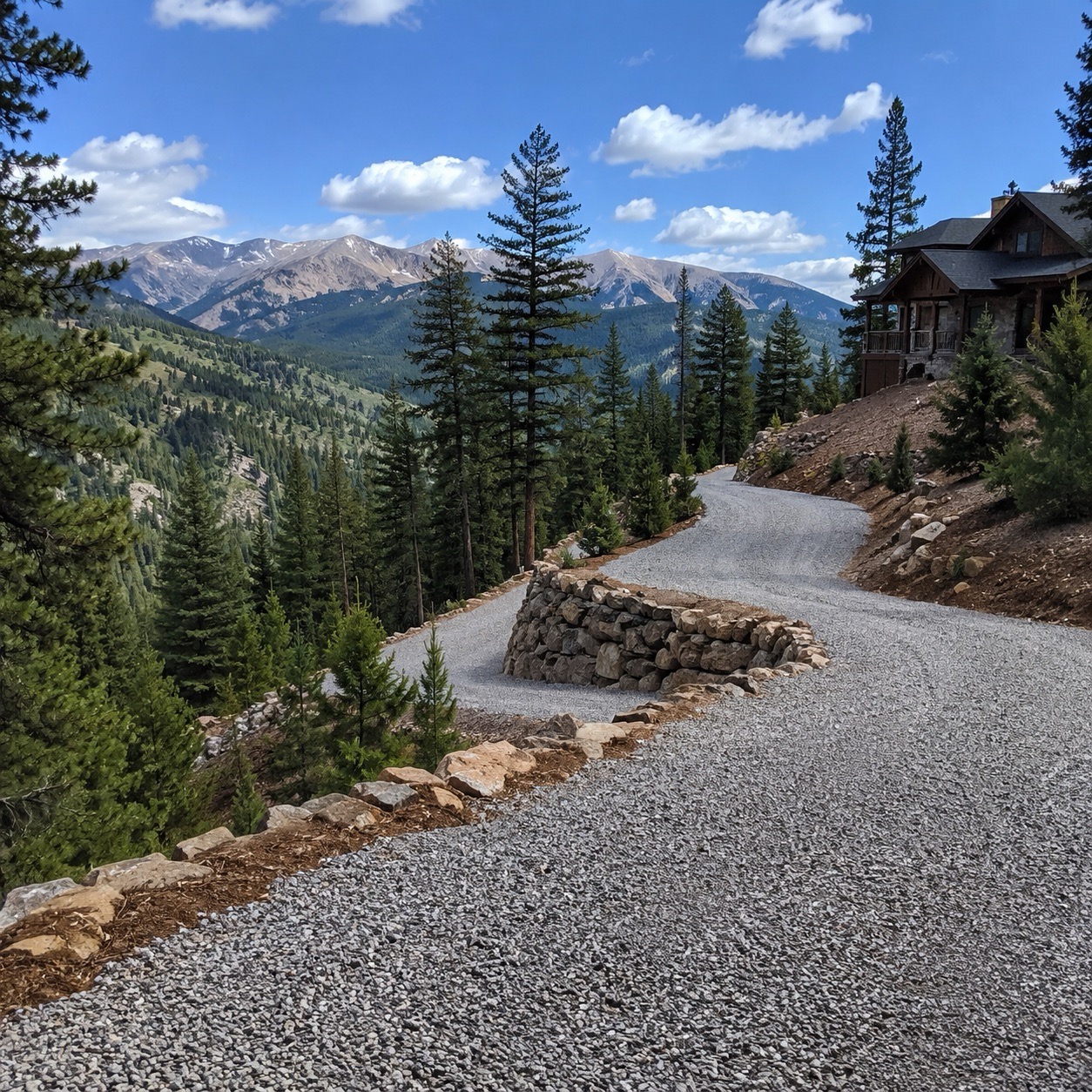
New driveway construction on undeveloped mountain property has the widest price range of any excavation service because every site is different. A relatively flat 200-foot driveway with decent soil and minimal clearing might come in around $10,000-$15,000. A 500-foot drive with switchbacks, rock removal, multiple culverts, and heavy tree clearing on a steep lot can hit $40,000-$50,000 before permitting and engineering costs are added.
Colorado-specific contractor data puts installed gravel driveways at roughly $15-$35 per linear foot depending on width, base depth, and terrain difficulty (Tri-Lakes Contracting). At those rates, a 200-foot drive runs $3,000-$7,000 in base material and grading alone, before culverts, clearing, or drainage work.
What drives the price on a new build:
- Length and width — every additional foot adds material and grading time
- Slope and grade — steeper drives need more cuts, more fill, and more drainage
- Rock and soil conditions — hitting bedrock can add $15,000-$20,000+ to a project (HomeGuide)
- Tree and stump removal — clearing along the driveway route runs $4,000-$6,000 per acre in Colorado’s mountain communities
- Culverts and drainage — one to three culverts is standard on mountain drives
- Switchbacks — double or triple the linear footage and require culverts at each turn
- County permits, surveys, and engineering — fees and requirements vary widely by county

What Materials Cost in Colorado
Material is one of the biggest line items on any driveway project, and Colorado pricing runs higher than national averages.
Current Colorado pricing from Ainsworth Rock Sales in Denver:
- Class 6 road base: $39.95 per ton — this is the standard driveway base material
- Pea gravel: $65.95 per ton
- Mountain granite: $76.95 per ton
- Colorado rose: $93.95 per ton
Recycled asphalt pavement (RAP) runs significantly cheaper at $20-$30 per ton from Colorado suppliers like Aggregate Markets in Louisville and Colorado Aggregate Recycling in Golden. RAP self-bonds when compacted and heated by sun exposure, making it a strong option for steep grades where loose gravel migrates downhill.
For reference, one ton of Class 6 road base covers roughly 90-100 square feet at 3 inches of depth. A typical 12-foot-wide, 200-foot-long driveway (2,400 square feet) needs approximately 24-27 tons of base material just for the surface layer. Most mountain contractors recommend 5-6 inches minimum for residential driveways, with 8-12 inches for drives that carry RVs, propane trucks, or heavy plows.
What Add-On Features Cost
These are the line items that catch people off guard when they’re budgeting a mountain driveway project.
Culverts: $1,000-$9,000 installed
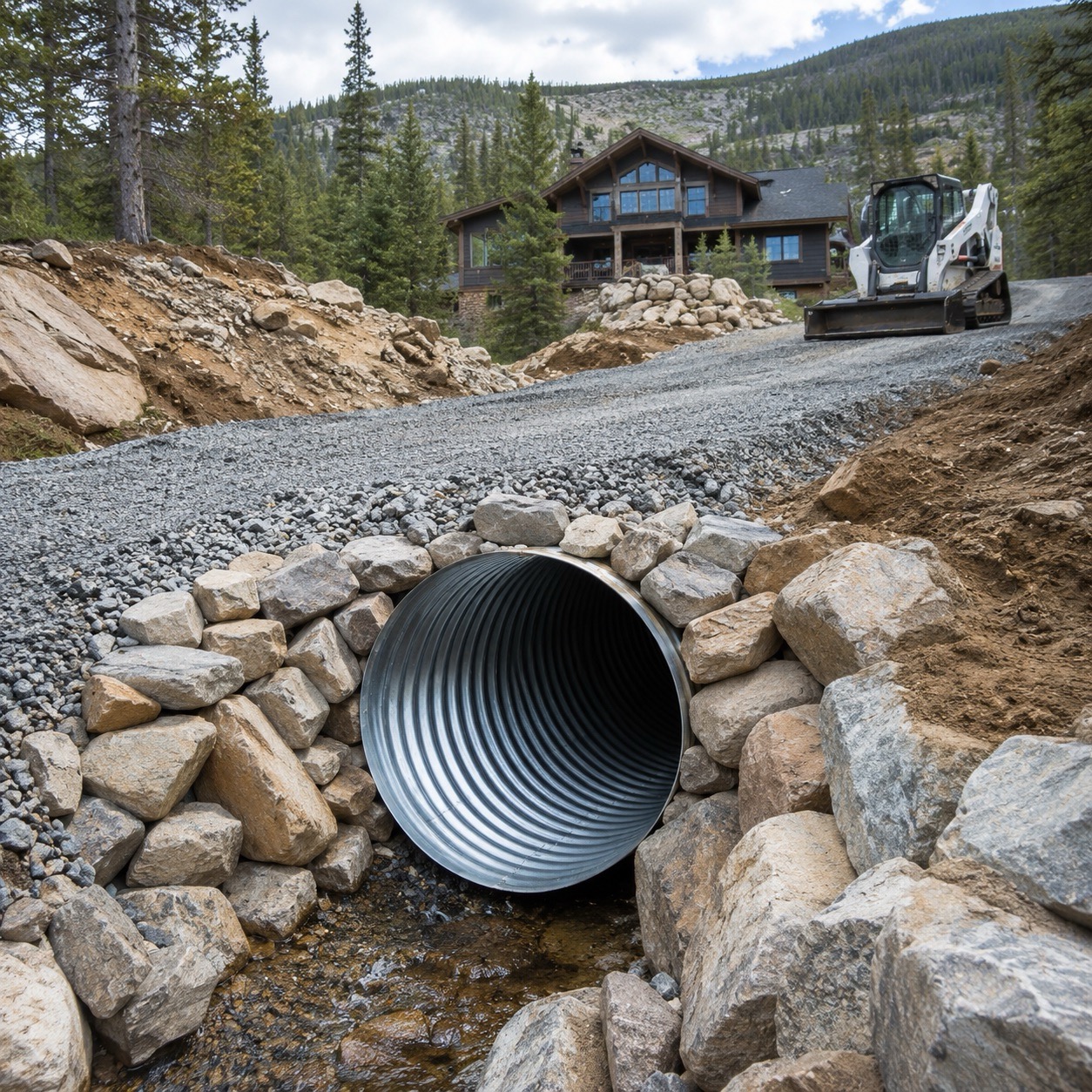
Most mountain driveways need at least one culvert for drainage crossings. The national average is around $4,500 installed (Angi). Colorado mountain installs tend to land in the $2,000-$5,000 range for a standard 15-18 inch residential pipe with headwalls and riprap.
Automated gates: $2,400-$8,000
Manual gates start around $300-$1,200. Automated gates with motors, keypads, and solar power average around $3,100-$3,200 nationally and can reach $8,000+ for custom or RV-width installations (HomeAdvisor, Angi).
Driveway lighting: $50-$200 per fixture
Solar-powered pathway lights on the lower end, professional low-voltage landscape lighting on the higher end. Full driveway lighting systems typically run $2,000-$6,000 depending on length and fixture count (Angi).
Drainage systems: $1,500-$5,500
French drains, channel drains, and surface water management systems. French drains alone can range from $1,000 to $18,000 depending on length and depth. Regrading for drainage correction runs $1,500-$9,500.

Why Mountain Driveways Cost More
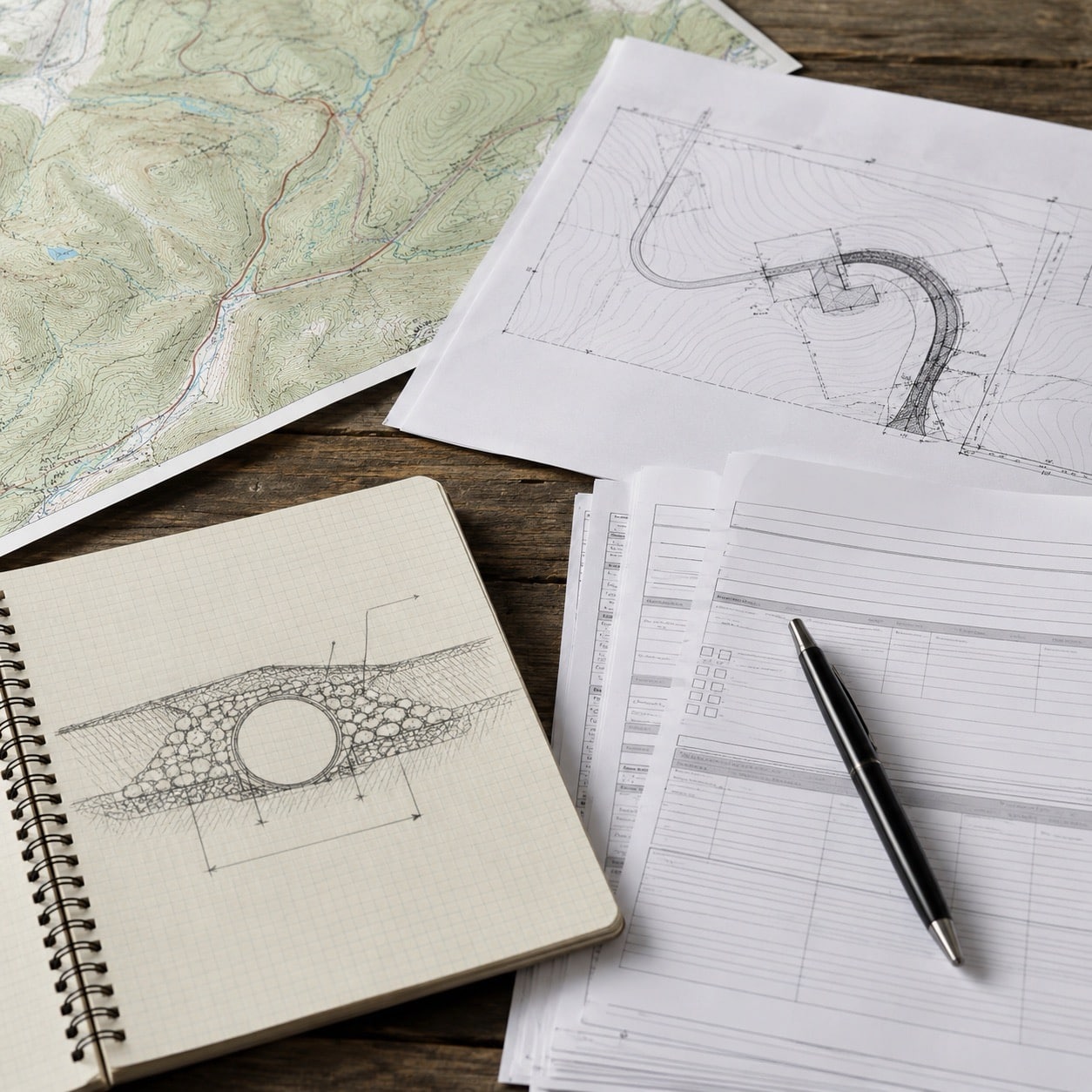
Colorado mountain properties carry a 20-50% cost premium over flat-land work according to HomeGuide. Several factors stack on top of each other.
Rock removal is the single biggest cost surprise. Removing rock and storing it on-site runs $50-$200 per cubic yard. Hauling it off jumps to $220-$250 per cubic yard. When an excavator hits unexpected bedrock, the bill can climb $15,000-$20,000 in a single project.
Steep grade excavation costs $2.50-$7.50 per square foot in Colorado compared to $1-$3 nationally for flat-land grading (HomeAdvisor). That premium covers the additional machine time, operator skill, and drainage engineering that mountain grades demand.
The building season is compressed. Most mountain excavation work happens between June and October. Frozen ground, mud season, and snow access limitations mean contractors have roughly five months to do twelve months of work. That compression affects scheduling, availability, and pricing.
Frost lines run deeper in the mountains. The Front Range minimum is 36 inches. Summit, Park, and Gilpin counties can hit 48-60 inches or more. Deeper frost means deeper culvert installs, deeper base layers, and more material to prevent frost heave damage.
Colorado’s overall construction costs run roughly 8% above the national average (CostFlowAI), and mountain-specific work adds another layer on top of that baseline.
Get an Accurate Number for Your Property
These ranges give you a starting point, but the only way to get a price that means something is a site visit. Every mountain property has different soil, different slope, different access, and different drainage conditions. We provide free consultations and detailed estimates for driveway renovation, new construction, and access road projects across Jefferson, Clear Creek, Gilpin, Park, Summit, and Douglas counties.
Contact us about your driveway project
Mountainside Land Services | 720-303-1449 | Serving Colorado’s Front Range mountain communities