
Every mountain homeowner hits this point eventually. The driveway is getting worse every year, spring runoff tears it up, and you’ve been throwing gravel at the same potholes for the third season in a row. The question is whether it makes more sense to keep maintaining what’s there or tear it out and start over.
The answer depends on what’s actually failing. Surface damage is fixable. Base failure is not. Knowing the difference will save you from spending thousands on repairs that won’t last, or from replacing a driveway that only needed grading and a fresh layer of material.

When Repair Is the Right Call
If the damage is on the surface and the base underneath is still solid, repair is almost always the better move.
Signs that grading and resurfacing will fix the problem:
- Isolated potholes in different spots, fewer than 3 per 100 linear feet, and under 2 inches deep
- Washboarding (those rhythmic ripples) limited to specific sections like hills, curves, or braking zones
- Rutting under 1-2 inches that smooths out with a blade
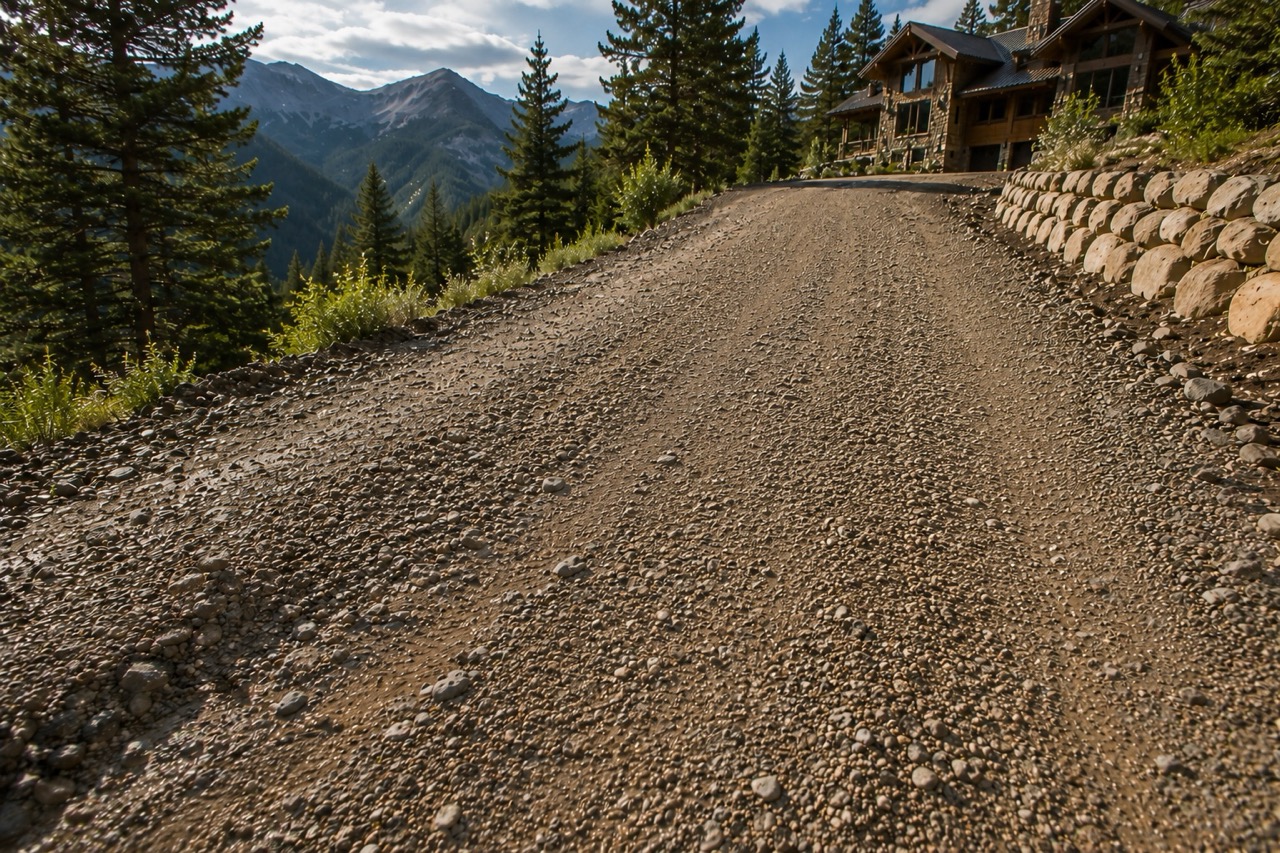
- Gravel thinning across the surface but the subgrade underneath still feels firm when you walk on it
- Damage covering less than 25% of the total driveway surface
A professional grading with fresh road base typically runs $500-$1,500 for a standard mountain driveway, and $3,500+for a full renovation that includes subgrade compaction and 3 inches of new material. At those prices, surface repair makes financial sense as long as the underlying base is intact and the same problems aren’t showing up in the same spots every single season.
The key test is simple: after grading and adding material, does the driveway hold up through one full freeze-thaw cycle and one spring runoff? If yes, your base is still doing its job. If the same ruts and holes reappear in the same locations within a few months, you have a base problem, and topping gravel is wasted money.
When the Driveway Needs Full Replacement
Base failure is the line between “worth repairing” and “needs a rebuild.” Once the structural layer underneath the surface gravel has been compromised, every dollar spent on top-dressing is going into the ground. Literally.
The indicators that point to base failure:
- Mud pumping through the gravel. After rain, you see clay or mud squeezing up between the stones. This means the subgrade fines have contaminated your aggregate layer. A 6-inch gravel layer that’s mixed with clay functionally becomes a 3-inch layer that holds water instead of shedding it.
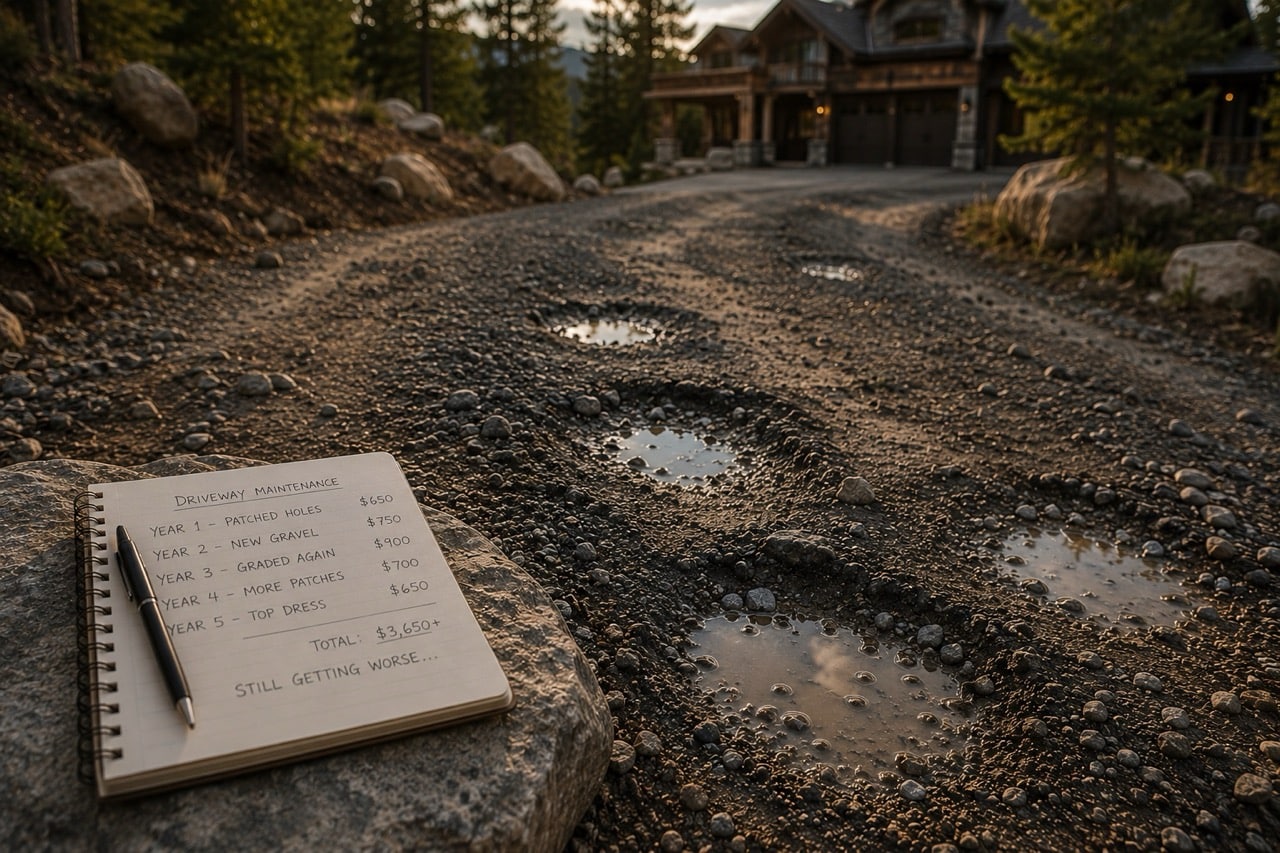
- Recurring potholes in the same locations within a single season. Isolated potholes in random spots are surface wear. The same holes opening up in the same places after you’ve already filled them means the base has failed at those points.
- Ruts deeper than 2-3 inches that reopen within weeks of grading. USDA Forest Service research identifies this depth as the threshold where water flow patterns reorganize and erosion accelerates dramatically (USDA Forest Service).
- Fresh gravel disappearing into the subgrade. You add material and it seems to vanish within a season. The aggregate is sinking into saturated, failed base material underneath.
- Crown loss with water running down the center of the driveway instead of sheeting off the sides.
- Erosion rills over 4 inches deep cutting across the driving surface.
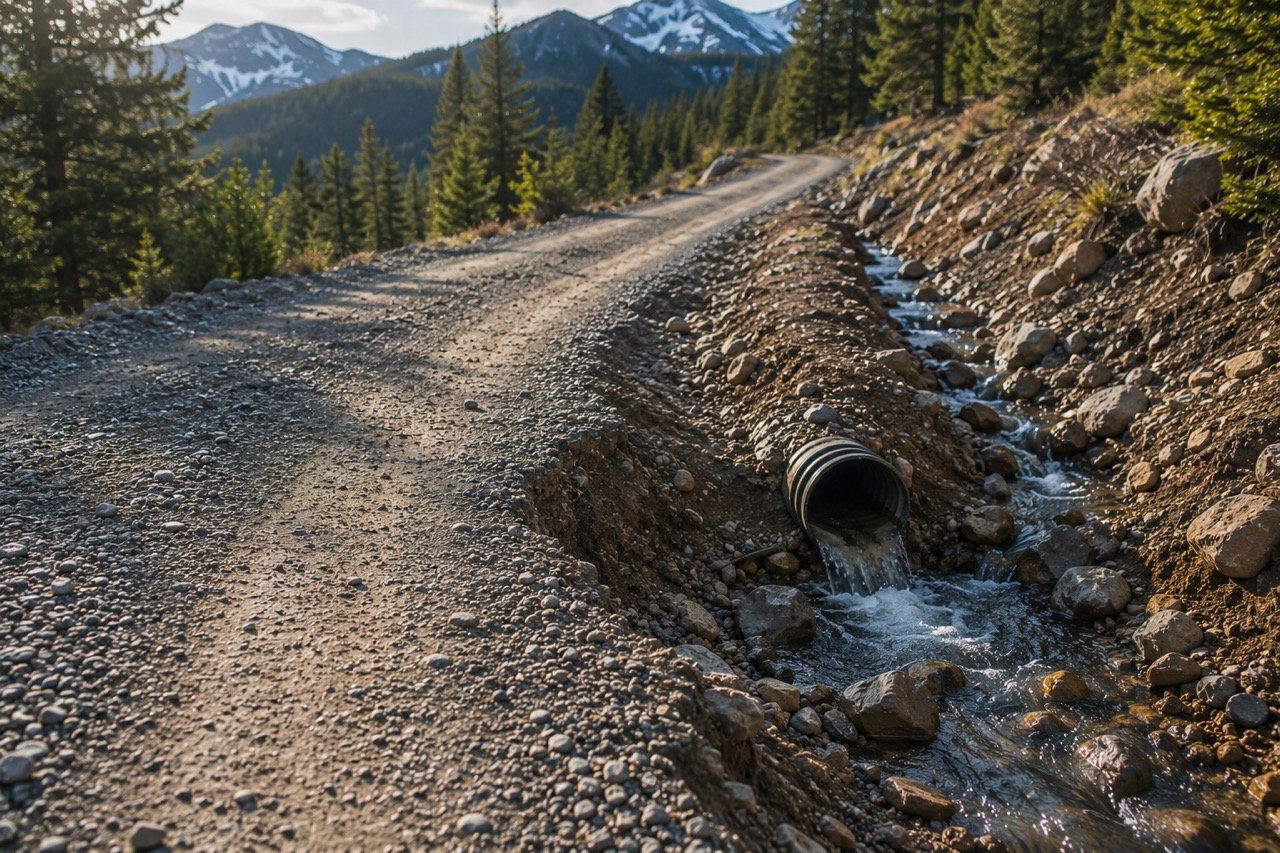
- Edge collapse or culvert washouts undermining the road shoulders.
When three or more of these show up together, you’re past the point of repair. The driveway needs to be stripped down to subgrade, recompacted, rebuilt with proper base layers, and regraded with correct crown and drainage from scratch.

The 50% Rule
The construction industry uses a straightforward guideline for the repair-or-replace decision: when repair costs exceed 50% of what a full replacement would cost, replace. This rule shows up across FEMA damage assessments, property management, and infrastructure maintenance planning.
For mountain driveways, the math works out like this:
Routine maintenance (annual grading, occasional pothole fill, top-dressing every 2-3 years) runs $500-$1,200 per year. Over five years, that’s $2,500-$6,000. This is the cost of a healthy driveway on a normal maintenance schedule.
Aggressive patching on a driveway with recurring problems (multiple grading visits, repeated gravel additions, spot drainage fixes) can reach $1,500-$3,000 per year, or $7,500-$15,000 over five years.
A full rebuild (strip, regrade, new base, new surface, drainage corrections) typically costs $3,500-$10,000 for a standard mountain driveway, more for longer drives or severe terrain.
When your annual maintenance spend crosses 15-20% of what a rebuild would cost, the driveway is past its economic service life. At $1,500-$3,000 per year in patching against a $7,000 rebuild cost, you’re spending 20-40% of replacement value annually. That’s the signal to stop feeding the problem and invest in a proper rebuild that resets the clock.

How Freeze-Thaw Wrecks Mountain Driveways
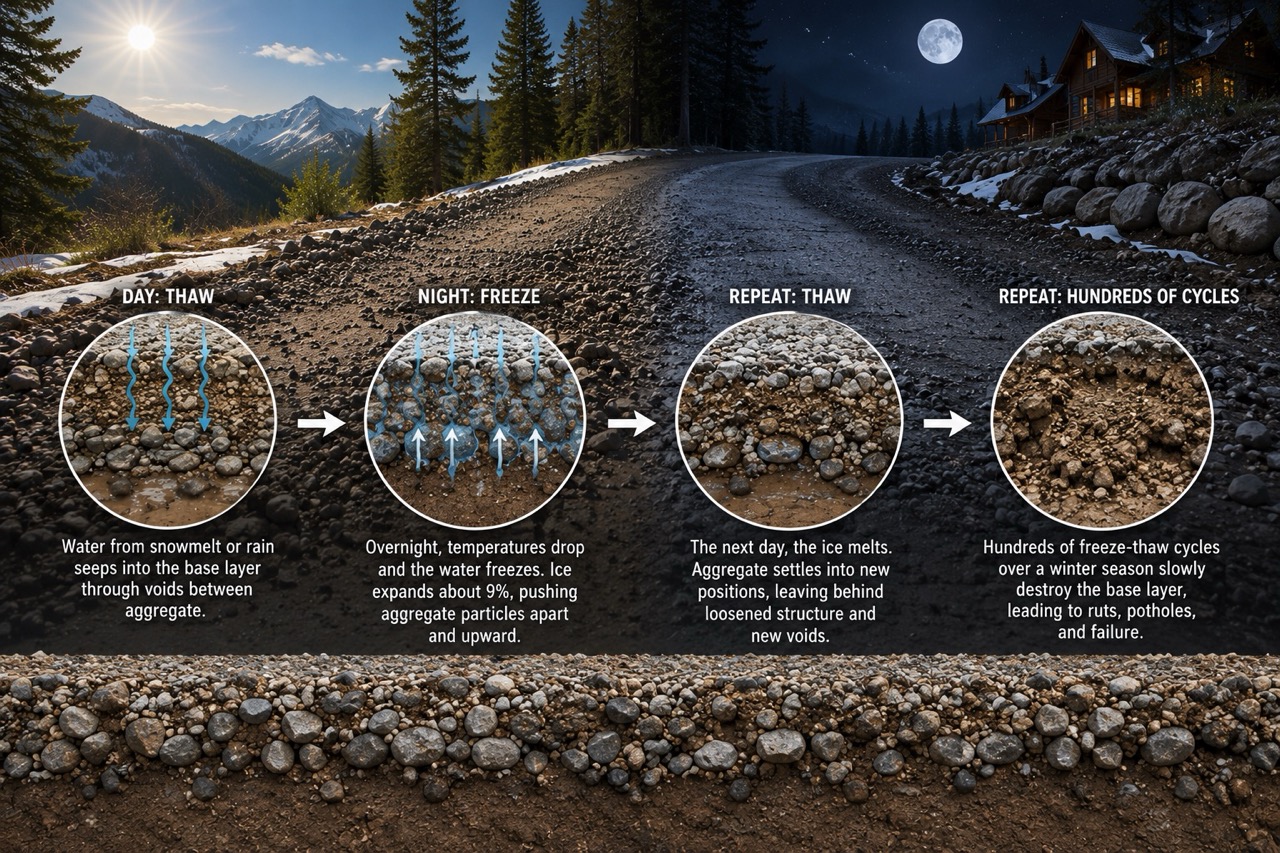
Water expands roughly 9% when it freezes. In Colorado’s mountain counties, this expansion and contraction cycle happens constantly.
Colorado’s Front Range mountains experience extreme daily temperature swings. It’s common to see 40-60°F shifts within a single 24-hour period. High-altitude solar radiation thaws surface material during the day even when air temperatures are below freezing, then rapid overnight cooling refreezes everything. This creates far more freeze-thaw cycles per winter than flatter, lower-elevation areas.
What this means for your driveway: water seeps into the base layer during the day, freezes overnight, expands, and pushes aggregate apart. The next day it thaws, the aggregate settles into a slightly different position, and water fills the new gaps. Repeat this hundreds of times over a single winter and the base slowly loses its structural integrity.
Realistic mountain driveway lifespans:
You’ll see marketing claims of gravel driveways lasting “up to 100 years.” In Colorado’s mountains, the numbers are different. Hello Gravel (Berthoud, CO) puts the range at 10-25 years with routine maintenance. High-traffic mountain driveways with steep grades, plow damage, and heavy runoff exposure typically need major resurfacing or full re-basing every 7-15 years.
Top-dressing (adding 1-2 inches of fresh gravel) should happen every 1-3 years. Grading should happen at least twice a year in freeze-thaw regions, ideally spring and fall.
The Cost of Waiting Too Long
Driveway problems on mountain properties compound fast. Every freeze-thaw cycle makes existing damage worse, and spring runoff turns small issues into expensive ones.
A $500 spring grading job delayed by one winter can become a $5,000+ rebuild once freeze-thaw cycles pump clay into the aggregate layer and spring runoff carves rills through the failed surface.
A 2-inch pothole left through one Colorado mountain winter can become an 8-inch depression by spring as water repeatedly freezes and expands in the hole.
A clogged or crushed culvert left unaddressed leads to water overtopping the driveway, eroding the embankment, and potentially taking out 20-30 feet of road surface. Emergency culvert replacement and driveway reconstruction in that scenario can run $10,000+.
There’s also the safety angle. In wildfire evacuation zones across Jefferson, Clear Creek, Gilpin, Park, and Summit counties, your driveway is your evacuation route and the fire department’s access road. A driveway with 2-3 inch ruts might feel like a nuisance in summer, but it can trap a 30,000-pound fire engine in wet conditions. FEMA recognizes driveway damage as eligible for repair assistance specifically when emergency vehicles are unable to reach a residence.
The pattern is consistent: early intervention costs a fraction of what delayed repairs cost. Every season you wait, the price goes up.

Get Your Driveway Assessed Before the Next Season
If you’re seeing the same problems come back year after year, it’s worth getting a professional assessment to find out whether you’re dealing with surface wear or base failure. We’ll walk your driveway, check the subgrade, evaluate drainage, and give you a straight answer on whether repair or replacement makes more sense for your property and your budget.
Contact us about your driveway
Mountainside Land Services | 720-303-1449 | Serving Colorado’s Front Range mountain communities