
The blog explains why a cheaper hourly rate does not always mean a cheaper job, what a crew is actually doing beyond operating equipment, and how hauling, access, utilities, and mountain site conditions can change the crew needed. That gives readers a better way to compare estimates based on scope and productivity, not just headcount or hourly price.
A three-person excavation crew will usually cost more per hour than one operator and one machine.
That does not mean it will cost more to finish the job.
On a Colorado mountain property, excavation rarely happens in isolation. Dirt has to go somewhere. New material has to come in. Trenches may cross existing utilities. Driveways need material placed, graded, and compacted. Tight access can determine which machines can work together and where trucks can turn around.
Once those pieces enter the job, crew size stops being a headcount problem. It becomes a production problem.
The question is not simply, “How many people am I paying for?” It is: “What is each person and machine doing to keep this project moving?”
One Operator Works When One Machine Can Keep Working
There are plenty of excavation jobs where a skilled operator and the right machine are the efficient choice.
A small grading job is a good example. So is stump and root removal, straightforward excavation, or clearing where material can be moved and placed within the same work area.
Mountainside Land Services handles everything from rough grading and trenching to cut-and-fill work and slope preparation through our excavation and sitework services. If the operator can dig, move, shape, and place material without constantly stopping for another part of the job, adding more people does not automatically make the work faster.
That is the part that gets lost when people compare crew sizes.
A five-person crew standing around one machine is not efficient. Neither is one operator trying to do a job that really requires several moving parts.
The crew has to fit the work.
The Cost Changes When the Excavator Starts Waiting
An excavator can dig faster than many jobs can handle the material it produces.
Imagine a site where soil has to leave the property. The excavator loads a truck. The truck leaves. If that truck has a long haul to a disposal location and there is nothing else productive for the excavator to do, the machine sits.
The hourly cost may look lean because there are fewer trucks and fewer people on site. The project itself can take longer.
The U.S. Army Corps of Engineers describes large excavation operations in much the same way. Its earthwork planning uses excavation systems made up of the excavator, supporting equipment, labor, and enough haul trucks to keep the excavator productive. The required number of trucks changes with the round-trip haul time.
A residential mountain job is obviously much smaller than a federal earthwork project. The production problem is the same.
If the expensive machine is waiting on the cheapest part of the operation, the crew is out of balance.
That is why a crew that costs more per hour can sometimes move the same amount of material for less money overall.
Hauling Can Set the Pace for the Entire Job
Hauling is one of the clearest examples because distance turns directly into time.
If excavated soil can be reused elsewhere on the property, the operator may be able to cut from one area and place material in another. That reduces trucking and keeps more of the work inside the site.
Mountainside uses cut-and-fill balancing where practical for exactly that reason: material from higher areas can sometimes be used to build lower areas instead of paying to haul usable soil away and bring replacement material back in.
But some jobs produce material that has to leave.
Now the excavation rate depends partly on how quickly trucks can load, leave, unload, return, and get back into position. Narrow mountain roads, limited turnaround space, steep access, and longer disposal runs can stretch that cycle.
The Federal Highway Administration warns against assuming one standard production rate even for the same type of construction work. Project size, location, equipment, and crew makeup can all change how much work gets completed in a given period.
That is the number worth watching: production. Not how cheap one worker looks on paper.
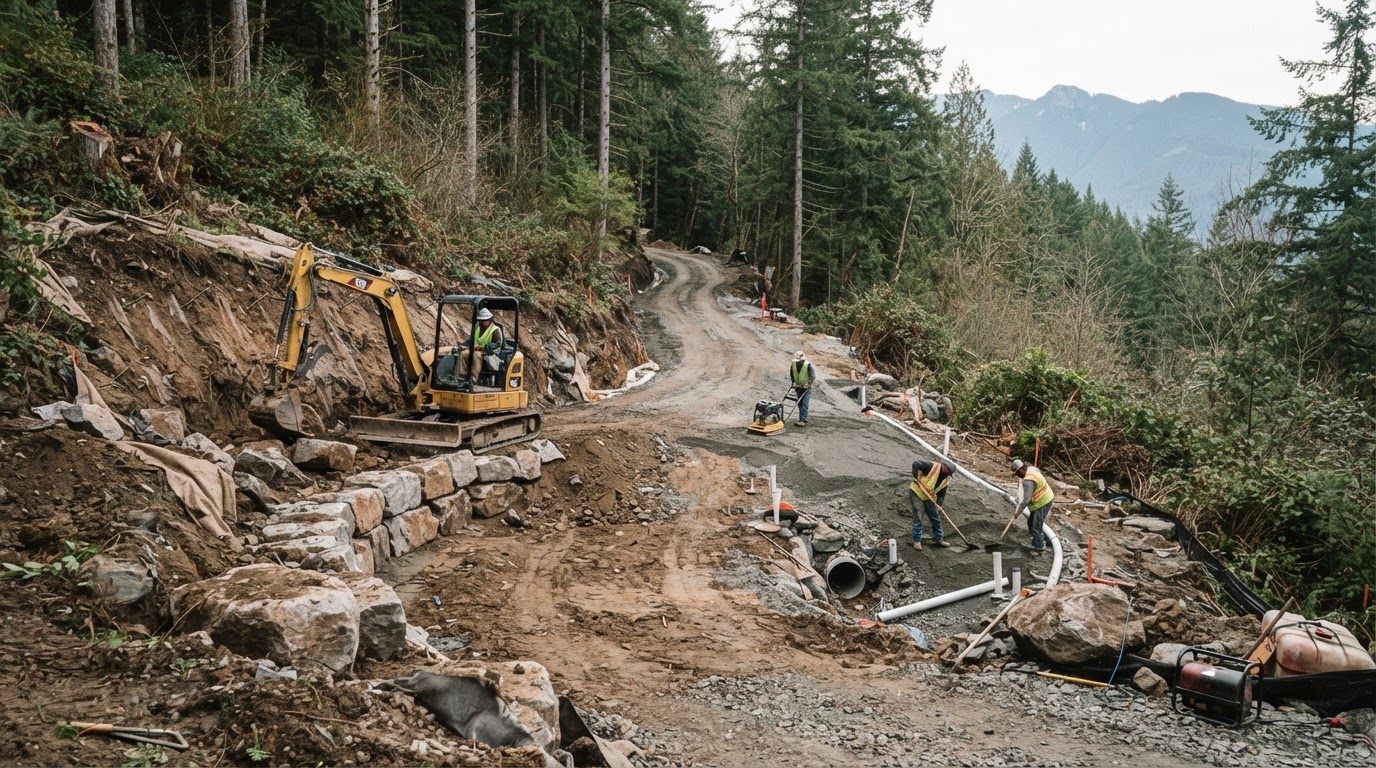

Driveway Work Shows Why Crew Rates Get Complicated
A mountain driveway is a good example because very little of the job consists of simply digging.
A new driveway or access road installation can involve route excavation, grading, culverts, drainage paths, imported road base, material placement, widening, and final surface work.
One machine may cut the route.
But material still has to arrive. Culverts have to be installed. Gravel has to be spread. Each layer has to be graded correctly. The finished road surface needs proper compaction.
Mountainside’s driveway renovation process, for example, includes subgrade compaction, fresh road material, regrading for drainage, and final compaction with a vibratory roller.
At that point, comparing the hourly rate of one operator against the hourly cost of the full crew misses the point.
You are buying a finished driveway, not eight hours of excavator movement.
Sometimes the Machine Has to Stop
Not every extra labor hour exists to increase production.
Some work simply cannot be done safely by putting the bucket down and digging faster.
Colorado 811 requires utility locates before excavation regardless of how shallow the planned dig is. Within the 18-inch tolerance zone around marked utilities, excavation requires additional care and non-destructive methods such as hand digging or vacuum excavation. Here’s more about Colorado 811 excavation requirements.
That becomes relevant on utility trenching, drainage work, foundation excavation, and older properties where multiple services may already cross the work area.
There can also be private lines that the normal 811 locate does not mark, including septic systems, irrigation, buried tanks, and some privately owned service lines.
So when a crew reaches an existing utility area, production can slow by design.
That is not wasted labor. It is part of doing the excavation without turning a trench into a damaged gas, electrical, water, or communication line.
Excavation Safety Can Change How the Crew Works
Deeper excavation introduces another set of requirements.
OSHA requires excavations where employees may be exposed to hazards to be inspected by a competent person before work begins, as needed during the shift, and following rain or other events that can increase risk. The competent person has to recognize dangerous conditions and have authority to correct them. You can read more about OSHA excavation requirements here.
Conditions can also change during the job.
A trench that was stable in the morning can behave differently after water enters it. Spoil placement, equipment near the edge, changing soil, and deeper excavation can all affect how the work proceeds.
That does not mean every excavation requires a large crew. It means some labor on a job is there because the work requires more than an operator moving dirt.
A Smaller Crew Is Not Always Cheaper
This is where hourly comparisons get people in trouble. A smaller operation can absolutely be the cheapest option when the work suits it.
But cutting the crew too far can create its own costs:
- Machines waiting for trucks or materials
- Operators stopping to perform work another crew member could handle
- Slow material movement between excavation, placement, and compaction
- Longer haul cycles controlling the pace of the entire job
- Hand work near utilities slowing machine production
- Multiple mobilizations because one phase cannot follow the previous one efficiently
None of those automatically justifies adding people. They simply show why the lowest crew rate and the lowest completed project cost are not the same thing.
Ask What the Crew Is There to Do
If you receive an excavation quote that includes several operators, machines, trucks, or laborers, asking about the crew is reasonable.
Here are some useful questions you can ask:
- What is each machine doing?
- Is material staying on site or being hauled away?
- How many trucks are required? Is grading included?
- What about compaction?
- Does the work involve existing utilities?
- Will material be imported?
- Are there portions that require hand work?
A contractor should be able to explain why the crew fits the scope.
For Colorado mountain work, that scope can include steep access, narrow work areas, long haul distances, drainage work, rock, imported material, and limited room for equipment to stage or turn around.
That is why Mountainside prices the property and the work in front of us instead of trying to force every excavation into one operator rate or one standard crew.
If you are planning excavation, sitework, a driveway, or other earthwork on a Colorado mountain property, contact Mountainside Land Services with your property location and project details. We can look at what the job actually requires and build the crew around the work.