
Excavation pricing in Colorado can vary widely depending on how the work is priced, what equipment is required, and what the site allows. This guide breaks down excavation cost per hour, project pricing, equipment costs, and the Colorado-specific factors that can change the final price, including rock, slope, access, permits, hauling, and difficult mountain conditions.
If you call three excavation contractors and ask, “What do you charge per hour?” you can get three different numbers and still know almost nothing about what your project will cost.
That is especially true in Colorado’s mountain communities. A clean dig on an open lot is one job. A foundation cut into a slope, a driveway through rocky ground, or a trench that equipment can barely reach is another.
The better question is: what are you pricing, and what does that price include?
Excavation can be priced by the hour, by a measured quantity, or as a complete project. Mountainside Land Services uses several of those approaches across its excavation and sitework, driveway, foundation, trenching, and land-clearing work because the work itself is not all measured the same way.
An Hourly Rate Only Tells You What One Hour Costs
Hourly pricing makes sense when the amount of work is hard to pin down before digging starts.
That can happen on repair work, exploratory digging, cleanup, regrading, or jobs where subsurface conditions are uncertain. But an equipment-hour price is not the same thing as an operator’s hourly wage.
Colorado Department of Transportation pricing rules make that distinction clear. CDOT’s equipment-rate method accounts for costs tied to owning and operating machinery, including fuel, maintenance, repairs, depreciation, insurance, overhead, attachments, and other operating expenses. These are public-works rules, not Mountainside’s rate sheet, but they show why a machine rate covers much more than the person in the cab. CDOT’s current construction specifications are here.
That matters on mountain sites because equipment choice affects production.
Mountainside uses a mini excavator for some clearing and root-removal work, while its broader capabilities include rough grading, cut-and-fill, foundation excavation, drainage trenches, culvert preparation, hauling, and slope work. The right machine for a narrow clearing area is not automatically the right setup for moving a large volume of material.
A lower hourly rate can lose its advantage fast if the equipment is wrong for the work.
Some Excavation Is Better Priced by What Gets Done
Mountainside’s own published pricing shows why “excavation cost per hour” is too narrow.
A foundation excavation can be priced by volume because the plans give the contractor dimensions to work from. Mountainside currently lists basement excavation starting at $25 per cubic yard, with difficult mountain conditions pushing that figure higher.
Utility trenching is different. Mountainside lists it starting at $19 per linear foot because trench length gives the project a more useful unit of measurement.
Mountain land clearing is currently priced at $3,500 to $6,500 per acre, with vegetation density, tree size, slope, boulders, access, and disposal affecting the final number.
Then there are projects such as driveways, where the finished result matters more than the number of machine hours. Mountainside currently lists driveway renovations starting around $3,500, while a new driveway or access road on undeveloped land can run from roughly $10,000 to $50,000+ depending on length, grade, switchbacks, clearing, rock, culverts, drainage, permits, and engineering.
Those are four different ways to measure four different jobs:
- Cubic yards for volume-based excavation
- Linear feet for trenching
- Acres for land clearing
- Project pricing for work such as driveway construction
CDOT uses the same basic logic at a larger public-works scale, with some earthwork paid by quantity and other operations paid by the hour. The point is not that residential work should copy CDOT pricing. It is that the pricing unit should match the work being measured.

Colorado Mountain Ground Can Change the Job
A price works only as long as the assumptions behind it hold.
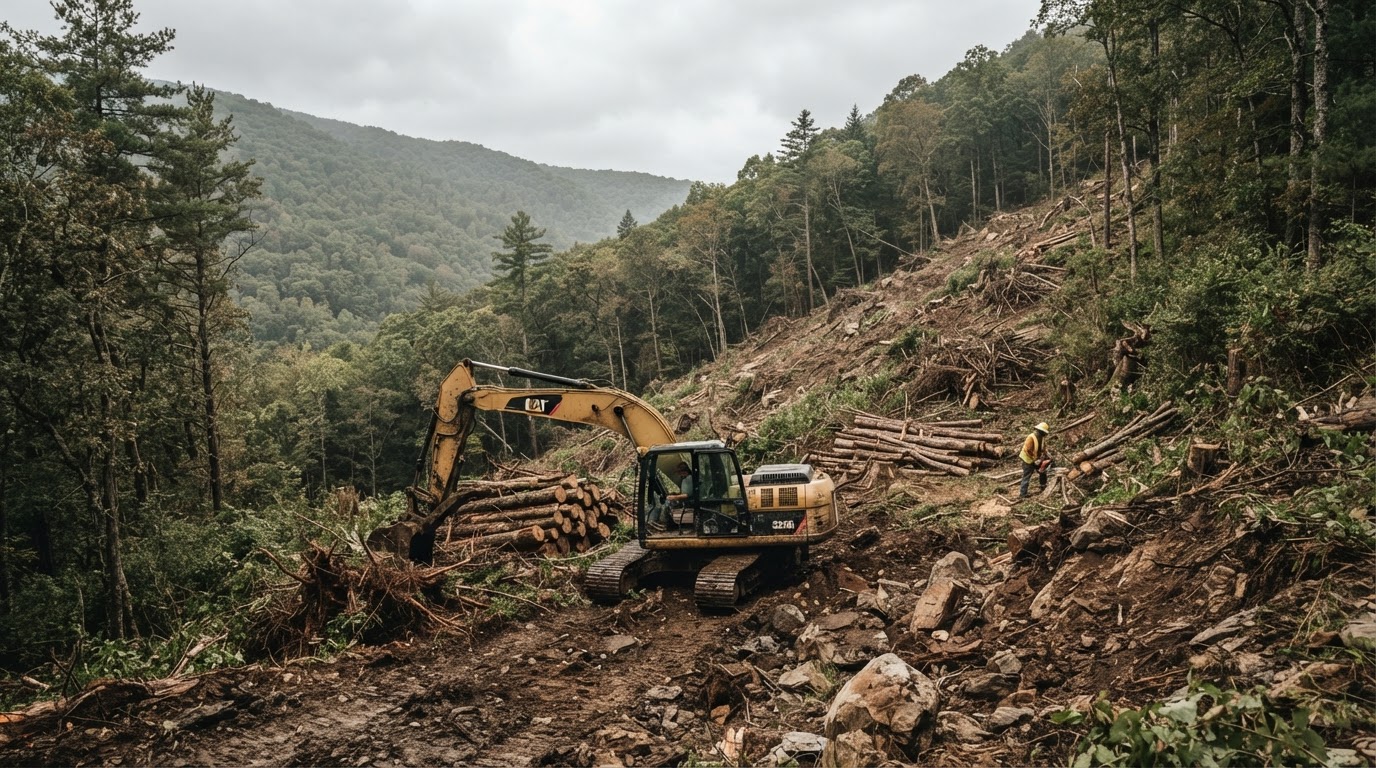
Rock is one of the clearest examples. CDOT separates rock excavation from ordinary unclassified excavation because rock can require different methods and production expectations. Mountainside makes the same distinction in its own pricing guidance: bedrock, large boulders, rocky soil, and hard digging conditions can raise excavation costs.
Slope adds another layer.
The Colorado Geological Survey notes that Colorado sees many landslides because of its steep terrain and identifies road cuts, trenches, water saturation, added loads, and removal of material at the base of slopes among conditions that can contribute to slope failure.
Colorado also has widespread expansive soils. The Colorado Geological Survey describes expansive soil and rock as the state’s most significant geologic hazard because certain clay-rich soils can swell as their moisture content changes. That matters to foundations, roads, driveways, and buried utilities.
None of that means every mountain project becomes a geotechnical problem. It means an estimate based on easy digging can stop describing the actual job if the crew encounters rock, difficult access, or conditions that require a different excavation plan.
This is where equipment matters more than the sticker rate. Mountainside’s excavation and sitework includes cut-and-fill balancing, spoil removal, drainage trenching, grading, and slope work. On driveway renovations, the company also uses a vibratory roller for final compaction.
The cost is tied to what it takes to finish the work, not simply how long one machine runs.
Some Costs Start Before the Excavator Does
County requirements can add work before digging begins.
Clear Creek County currently requires a Grading & Excavation Permit for projects involving more than 800 square feet of land disturbance, and projects disturbing existing slopes over 10% require a topographic and boundary survey. Its process can also require staking, temporary erosion controls, and inspections. Clear Creek County lists those requirements here.
Jefferson County uses different thresholds. Grading work disturbing more than half an acre can require a Grading Permit, while other land-disturbance work may fall under a Notice of Intent. Projects disturbing more than one acre also require a state construction stormwater permit. Jefferson County explains its earthwork requirements here.
Not every project triggers those requirements. But two similar-looking properties can carry different scopes once location, slope, acreage, access, and local rules are considered.
Compare the Work, Not Just the Rate
If two excavation quotes are far apart, the hourly number may not explain why.
One price may include mobilization and hauling. Another may not. One may include imported material and compaction. Another may cover excavation only. One contractor may be pricing a complete driveway with drainage and road base, while another number covers machine time and leaves the rest open.
Before comparing bids, ask what the number covers:
- Is the equipment and operator included?
- Is mobilization included?
- Who pays for trucking and disposal?
- Are imported materials included?
- Does the price include grading and compaction?
- What happens if the excavation hits rock?
- Are permits, surveys, or engineering part of the scope?
- Is the quote hourly, quantity-based, or fixed for the completed work?
The cheapest hourly rate is not automatically the cheapest project. That’s why Mountainside Land Services prices mountain property services around the work the site actually requires, from excavation and foundations to clearing and driveway construction.
If you have a project in Colorado’s Front Range or mountain communities, contact Mountainside Land Services with the property location and the work you are planning. A real site and a defined scope will tell you much more than a generic hourly rate ever will.